
DNA suggests body buried in feminine attire with swords had Klinefelter syndrome, researchers say
Modern analysis of a 1,000-year-old grave in Finland challenges long-held beliefs about gender roles in ancient societies, and may suggest non-binary people were not only accepted but respected members of their communities, researchers have said.
According to a peer-reviewed study in the European Journal of Archaeology, DNA analysis of remains in a late iron age grave at Suontaka Vesitorninmäki in Hattula, southern Finland, may have belonged to a high-status non-binary person.
First discovered in 1968 during building work, the grave contained jewellery in the form of oval brooches as well as fragments of woollen clothing suggesting the dead person was dressed in “a typical feminine costume of the era”, the researchers said.
But unusually, the grave also held a hiltless sword placed on the person’s left side, with another sword, probably deposited at a later date, buried above the original grave – accoutrements more often associated with masculinity.
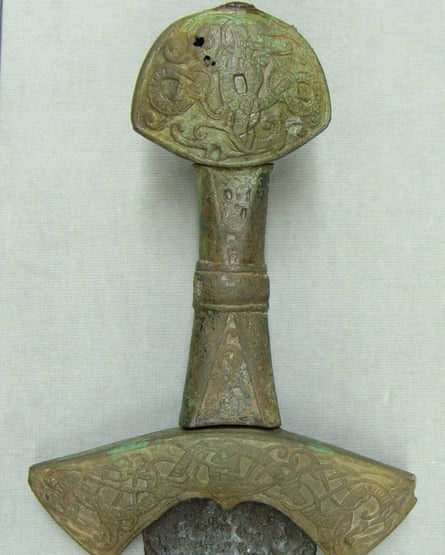
For decades, the researchers said, archaeologists had assumed either that two bodies, a man and a woman, had been buried in the Suontaka grave, or that it was evidence strong female leaders, even woman warriors, existed in early medieval Finland.
“The buried individual seems to have been a highly respected member of their community,” said the study’s lead author, Ulla Moilanen, an archaeologist from the University of Turku. “They were laid in the grave on a soft feather blanket with valuable furs and objects.”
DNA analysis, however, showed the grave held the remains of only one person – and that they had Klinefelter syndrome. Usually, a female has two X chromosomes (XX) and a male has one X and one Y (XY). In Klinefelter syndrome, a male is born with an extra copy of the X chromosome (XXY).
Males with the syndrome, which affects about one in 660 men, are still genetically male and often do not realise they have the extra chromosome, but the condition can cause enlarged breasts, a small penis and testicles, a low sex drive and infertility.
The Finnish researchers warned that the DNA results were based on a small sample and only a relatively small number of genetic sequences could be read, meaning they had to rely to some extent on modelling.
But they said that based on their data, it was likely that the body in the Suontaka grave had the chromosomes XXY. The high-status burial led them to conclude the person may have identified as outside the traditional gender divisions.
Related Posts

At 2 A.M., I Called My Parents in Tears and Begged, “Please Come Get Me and My 6-Year-Old Daughter. We Can’t Stay Here Another Night.” Mom Called Me Dramatic. Dad Told Me to Stop Blaming My Husband. Then I Discovered Why They Refused to Help: My Husband Had Been Secretly Paying Them $10,000 Every Month to Keep Them on His Side. I Hung Up, Took My Little Girl, and Disappeared Before Sunrise. By Morning, My Husband Was Calling in a Panic, Shouting, “What Have You Done?!” He’d Finally Discovered the One Secret About His Business Empire That I’d Kept From Him All Along

Just 90 Minutes Before My Wedding, My Son’s Nanny Walked Into My Room Holding My 11-Month-Old Baby and Whispered, “Please, Don’t Go Downstairs. You Need to Hear This First.” Then She Played a Recording of My Bride’s Secret Phone Call About My Fortune—and the Son I Had Always Believed Was Mine. I Listened in Silence as Her True Plans Unfolded. With 200 Guests Waiting Downstairs, I Made One Decision My Bride Never Saw Coming: I Canceled Our Wedding Before She Could Walk Down the Aisle

My 8-Year-Old Daughter Was Almost in Tears When the Restaurant Manager Pointed at My Muddy Boots and Said, “We Don’t Serve People Like You in This Section.” She Called Security, Gave Us Two Minutes to Leave, and Smirked as the Other Diners Watched. I Quietly Sent One Text Instead of Arguing. What She Didn’t Know Was That the Person Receiving My Message Could Change Everything About Her Future at That Restaurant

My 5-Year-Old Daughter Called Me at Work Crying, “Mommy, Dad’s Girlfriend Hurt Me With a Hockey Stick.” I Didn’t Confront Anyone—I Called for Help and Saved Every Message. At the Hospital, They Found Marks on Her Arm and Leg. But What Surfaced Just Before the Custody Hearing Revealed That Her Father Had Known Far More Than He Had Ever Admitted
